Welcome to Business Bites, the blog where food meets business strategy, and where every bite tells a story about what makes the biggest restaurant chains tick. If you’ve ever wondered why some restaurants become household names while others remain local favorites, you’re in the right place.
This series explores the decisions that transformed small restaurants into billion-dollar businesses. Every company has a unique story, and each one offers lessons in leadership, marketing, operations, and growth. Along the way, I’ll also share some of my favorite menu items because understanding the product is just as important as understanding the business behind it.
Today’s spotlight is on the company that turned a simple baked snack into a global franchise:
Auntie Anne’s
Part 35 – Auntie Anne’s
Most successful restaurant chains build their businesses around full meals. Auntie Anne’s did something much simpler. It built an international brand around a single snack that people could enjoy while shopping, traveling, or simply passing by.
That might sound limiting at first, but it became the company’s greatest advantage. Instead of competing directly with burger chains or coffee shops, Auntie Anne’s focused on owning an entirely different occasion. Customers weren’t visiting because they needed lunch or dinner. They were stopping because the smell of freshly baked pretzels made it almost impossible to walk past without taking a second look.
Today, Auntie Anne’s operates thousands of locations around the world, proving that a focused concept executed consistently can become just as successful as restaurants with much larger menus.
From a Farmers Market Stand to a Global Franchise
Auntie Anne’s was founded in 1988 by Anne Beiler at a farmers market in Downingtown, Pennsylvania. After purchasing a small pretzel stand, she began experimenting with recipes until she developed the soft pretzel that would eventually define the brand.
From the beginning, freshness became the company’s biggest selling point. Instead of shipping finished products to stores, pretzels were mixed, rolled, and baked throughout the day in front of customers. That process filled malls with the unmistakable aroma of warm bread and butter, creating free advertising every time someone walked by.
As shopping malls expanded throughout the 1990s, Auntie Anne’s grew alongside them. Rather than opening large standalone restaurants, the company focused on compact storefronts in locations with heavy foot traffic. Airports, outlet centers, train stations, amusement parks, and college campuses eventually became ideal locations because thousands of potential customers passed by every day.
Today, Auntie Anne’s is part of GoTo Foods, formerly known as Focus Brands, alongside Cinnabon, Carvel, Jamba, McAlister’s Deli, Moe’s Southwest Grill, Schlotzsky’s, and other well-known restaurant brands. Even as consumer habits have changed, Auntie Anne’s has continued expanding by bringing its products to wherever people naturally gather.
My Go-To Order

When diving into a business, you’ve got to taste the product, right? Here are the items I usually order from Auntie Anne’s and why I think they’ve become customer favorites.
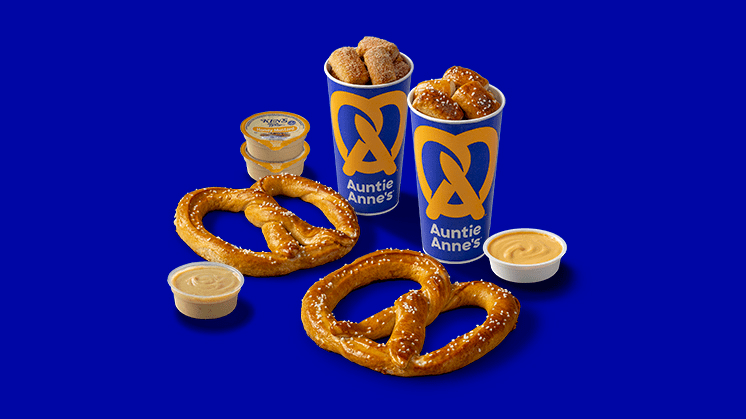
Original Pretzel: This is usually my order because it’s the product that built the company. Its simplicity highlights the importance of mastering one item before expanding into additional products.
Cinnamon Sugar Pretzel Nuggets: Bite-sized products make sharing easier while encouraging impulse purchases. They’re also an example of how one recipe can be repackaged into multiple products without dramatically increasing operational complexity.
Original Pretzel Dog: Adding hot dogs allowed Auntie Anne’s to reach customers looking for something slightly more filling while still staying true to its pretzel-focused identity.
Frozen Lemonade: Pairing salty snacks with refreshing drinks increases average transaction values while giving customers another reason to complete their purchase at the same store.
Overall, my order reflects Auntie Anne’s strategy of expanding thoughtfully around one core product instead of trying to become something entirely different.
The Business Behind the Billions
Mastering One Product Exceptionally Well
Many businesses try to offer everything from the beginning. Auntie Anne’s took the opposite approach by building its reputation around one product and making that product exceptionally consistent. Customers knew exactly what to expect every time they visited, whether they were in Pennsylvania, California, or another country.
Specialization often creates stronger brand recognition than offering dozens of unrelated products.
Choosing Locations Carefully
Location has always been one of Auntie Anne’s biggest competitive advantages. Instead of relying on customers to plan a visit, the company places its stores where millions of people already walk every day. Shopping malls, airports, and entertainment venues naturally generate impulse purchases because customers are already present.
Sometimes the best marketing strategy isn’t advertising at all. It’s simply being in the right place at the right time.
Selling Through the Senses
One of Auntie Anne’s most effective marketing tools isn’t a commercial or a social media campaign. It’s the smell of freshly baked pretzels. By preparing food in open kitchens throughout the day, the company creates an experience that immediately captures customers’ attention.
Businesses often overlook sensory branding, but sight, smell, and sound can influence purchasing decisions just as much as traditional advertising.
Growing Through Franchising
Franchising allowed Auntie Anne’s to expand rapidly without taking on the full cost of opening every new location. Entrepreneurs invested in local stores while benefiting from a recognizable brand, proven recipes, and established operating systems.
That combination enabled the company to grow internationally while maintaining a consistent customer experience across thousands of locations.
Expanding Without Losing Focus
Over the years, Auntie Anne’s introduced pretzel nuggets, pretzel dogs, dipping sauces, beverages, and seasonal products. While the menu became larger, every addition still supported the company’s central identity.
Successful innovation doesn’t always require reinventing the business. Often, it’s about finding thoughtful ways to strengthen the concept customers already enjoy.
Lessons From Auntie Anne’s for Aspiring Entrepreneurs
Strategy | What It Teaches |
|---|---|
| Specialization | Master one product before trying to master many |
| Location Strategy | Being where customers already are creates natural demand |
| Sensory Marketing | Experiences can become powerful forms of advertising |
| Franchising | Proven systems allow businesses to scale efficiently |
Final Thoughts
Auntie Anne’s proves that a business doesn’t need an enormous menu to become an international success. By focusing on one product, choosing strategic locations, and creating an experience customers remember long after they leave the store, the company built one of the most recognizable snack brands in the world.
What I find most interesting is that much of Auntie Anne’s growth came from understanding customer behavior rather than constantly chasing new food trends. The company recognized that convenience, consistency, and impulse buying could be just as valuable as offering dozens of menu options.
For entrepreneurs, there’s an important takeaway. Success often comes from doing one thing exceptionally well and putting that product in front of the right customers at exactly the right moment.
Want more bites of business?
Subscribe to get every new post delivered straight to your inbox.
Sources:
- Auntie Anne’s – Our Story
- GoTo Foods – Our Brands (Auntie Anne’s)
- Encyclopaedia Britannica – Anne Beiler
- Restaurant Business – Auntie Anne’s News & Analysis
- QSR Magazine – Auntie Anne’s Coverage
- Forbes – Auntie Anne’s & GoTo Foods Coverage
- Entrepreneur – Auntie Anne’s Franchise Profile
- Technomic – Restaurant Industry Insights
- Statista – Auntie Anne’s Statistics and Market Data
 Business Bites
Leave a comment