Welcome back to Business Bites, the blog where food meets business strategy. Every restaurant has a story, but not every story follows the same path. Some companies dominate because they invent something completely new. Others succeed because they execute better than everyone else.
Domino’s falls into the second category.
Today, Domino’s is one of the largest pizza chains in the world, serving millions of customers across dozens of countries. But what makes Domino’s particularly interesting isn’t just its size; it’s how the company transformed itself. At one point, Domino’s faced widespread criticism about its product quality. Rather than ignore the problem, it embraced it, improved, and turned itself into one of the most successful turnaround stories in the restaurant industry.
This week’s spotlight is on the company that proved convenience, innovation, and honesty can be just as important as the food itself: Domino’s Pizza.
Part 6 – Domino’s
For many people, ordering pizza and ordering Domino’s are almost the same thing.
That reputation wasn’t built overnight. For decades, Domino’s focused on making pizza delivery faster, easier, and more reliable than its competitors. While other chains invested heavily in dine-in experiences, Domino’s concentrated on getting food from the oven to customers’ doors as efficiently as possible.
That focus helped transform a single pizza shop in Michigan into a global business with thousands of locations around the world.
From One Pizza Shop to a Global Brand
The Domino’s story began in 1960 when brothers Tom and James Monaghan purchased a small pizza restaurant called DomiNick’s in Ypsilanti, Michigan.
Shortly after the purchase, Tom became the sole owner and eventually renamed the business Domino’s Pizza.
From the beginning, Domino’s emphasized simplicity and efficiency. Rather than offering a huge menu filled with different products, the company focused on making pizzas quickly and consistently. This approach made it easier to train employees, streamline operations, and expand through franchising.
As the company grew throughout the 1970s and 1980s, it became known for delivery. Domino’s built systems specifically designed to move orders through the kitchen and out the door as quickly as possible.
However, one of the most important moments in the company’s history came decades later. By the late 2000s, customer feedback revealed that many consumers weren’t impressed with the pizza itself. Domino’s faced a choice: defend the product or improve it.
The company chose improvement. After publicly acknowledging customer criticism, Domino’s redesigned its pizza recipe and launched a marketing campaign centered around transparency and change. The gamble paid off, helping fuel one of the most impressive turnarounds in the restaurant industry.
My Go To Order
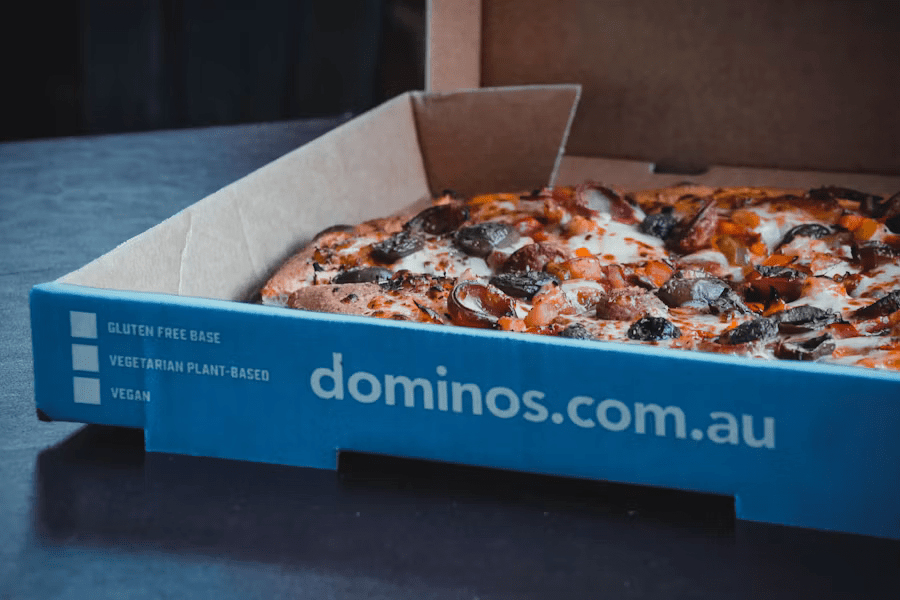
When looking at a restaurant business, you’ve got to understand the product too. Here’s what I usually order from Domino’s and why I think these items work so well:
Hand Tossed Pepperoni Pizza: Sometimes the classics are classics for a reason. The hand-tossed crust has a good balance of softness and crispness, and it’s the type of pizza that appeals to a wide range of customers.
Parmesan Bread Bites: These are probably my favorite side on the menu. They’re easy to share and complement almost any pizza order. From a business perspective, items like this help increase the average amount customers spend without requiring major additional ingredients.
Stuffed Cheesy Bread: One of the more unique items Domino’s offers. It gives customers another reason to choose Domino’s while using ingredients already found elsewhere in the kitchen, helping keep operations efficient.
Chocolate Lava Crunch Cakes: Easily one of the best desserts on the menu. They’re simple to add to an order and show how restaurants can use desserts to boost revenue while improving the overall customer experience.
The Business Strategies Behind the Billions
Owning the Delivery Experience
For decades, Domino’s focused on delivery more aggressively than almost any other restaurant chain. While many competitors viewed delivery as an additional service, Domino’s built its entire business around it. Store layouts, employee training, kitchen operations, and logistics systems were all designed with one goal in mind: getting food to customers quickly.
This strategy created a major competitive advantage. Long before food delivery apps became common, Domino’s had already spent years perfecting the delivery process. When customer preferences shifted toward convenience and at-home dining, the company was ready. Rather than scrambling to adapt, Domino’s was able to capitalize on trends it had been preparing for all along.
The lesson here is that businesses often benefit from focusing intensely on one area rather than trying to excel at everything. Domino’s became known for delivery because it made delivery the center of its business model.
Turning Criticism Into Opportunity
One of the most fascinating moments in Domino’s history occurred in 2009 when the company publicly acknowledged widespread criticism of its pizza recipe. Most companies try to hide negative feedback or quietly make changes behind the scenes. Domino’s took the opposite approach.
The company launched a campaign featuring real customer comments, many of which were highly critical. Executives openly discussed the feedback and explained how the company was redesigning its pizza from the ground up. The new recipe included changes to the crust, sauce, and cheese, and Domino’s documented the entire process publicly.
This strategy was risky because it brought attention to the company’s weaknesses. However, it worked because customers appreciated the honesty. Instead of appearing defensive, Domino’s appeared willing to listen and improve. The campaign helped rebuild trust and became one of the most famous examples of corporate transparency in recent history.
For entrepreneurs, the takeaway is simple: admitting mistakes and fixing them can sometimes strengthen a brand more than pretending the mistakes never existed.
Investing Early in Technology
Today, ordering food through an app feels completely normal. When Domino’s first began investing heavily in digital ordering, that wasn’t the case. The company recognized earlier than many competitors that technology could make ordering easier, faster, and more convenient.
Over the years, Domino’s introduced online ordering, mobile apps, voice ordering, and its famous Pizza Tracker feature, which allowed customers to monitor the progress of their orders in real time. These innovations improved the customer experience while also helping Domino’s gather valuable information about customer behavior.
Technology became much more than a convenience feature. It became a competitive advantage. By understanding ordering habits, popular products, and customer preferences, Domino’s could make smarter decisions regarding promotions, staffing, and menu development. Rather than viewing technology as an expense, Domino’s viewed it as an investment in long-term growth.
Franchising for Rapid Expansion
Like many successful restaurant chains, Domino’s relies heavily on franchising. Instead of opening every restaurant itself, the company allows franchise owners to invest in locations while following Domino’s systems and standards.
This model helps the company expand more quickly because franchisees provide much of the capital needed for growth. At the same time, Domino’s benefits from royalty income and a growing global footprint without assuming the full financial risk of every new location.
Franchising also helps create consistency. Customers expect a similar experience whether they’re ordering from a Domino’s in Texas, New York, or another country entirely. Standardized training, operational procedures, and quality controls help make that possible.
Simplicity and Operational Efficiency
Although Domino’s has expanded its menu over time, pizza remains at the center of the business. This focus creates significant operational advantages. Employees can be trained more efficiently, inventory is easier to manage, and stores can maintain consistency across locations.
Many businesses assume growth requires constantly adding new products and services. Domino’s demonstrates that there can be tremendous value in staying focused on a core offering while making incremental improvements around it. By keeping operations relatively simple, the company can concentrate resources on execution rather than complexity.
Operational efficiency may not be the most exciting business strategy, but it’s often one of the most profitable.
Lessons From Domino’s for Aspiring Entrepreneurs
Strategy | What It Teaches |
|---|---|
| Delivery Focus | Build expertise in one area and make it your advantage |
| Transparency | Honest feedback can become a powerful growth opportunity |
| Technology Investment | Use technology to improve both convenience and efficiency |
| Franchising | Strategic partnerships can accelerate growth |
Final Thoughts
Domino’s success wasn’t built solely on pizza. It was built on adaptability, convenience, and a willingness to evolve when necessary. The company understood that customer expectations change over time and that businesses must change with them. Whether improving its recipe, investing in technology, or refining its delivery systems, Domino’s consistently looked for ways to better serve customers.
Today, Domino’s stands as one of the strongest brands in the restaurant industry because it wasn’t afraid to acknowledge problems and make improvements. Its story serves as a reminder that success doesn’t come from being perfect. More often, it comes from learning, adapting, and continually finding ways to deliver more value to customers.
Up next on Business Bites: Raising Cane’s — the chicken chain that built a billion-dollar business by doing something most restaurants avoid: offering fewer choices. We’ll explore how simplicity became one of the most powerful competitive advantages in fast food.
Want more bites of business?
Subscribe to get every new post delivered straight to your inbox.
Sources:
- The Domino’s Story – Domino’s Corporate History
- Domino’s Annual Report – Domino’s Pizza Investor Relations
- How Domino’s Reinvented Its Pizza – Domino’s Pizza Turnaround Campaign
- The Pizza Turnaround That Changed Domino’s – Harvard Business Review
- Why Domino’s Is Really a Tech Company – Forbes Contributors
- How Technology Fueled Domino’s Growth – CNBC Restaurants Coverage
- Domino’s Statistics and Market Data – Statista Research Department
- How Domino’s Became a Delivery Leader – QSR Magazine
- Domino’s Franchising Information – Domino’s Franchise Development
- The Domino’s Turnaround Story – Restaurant Business Online
 Business Bites
Leave a comment